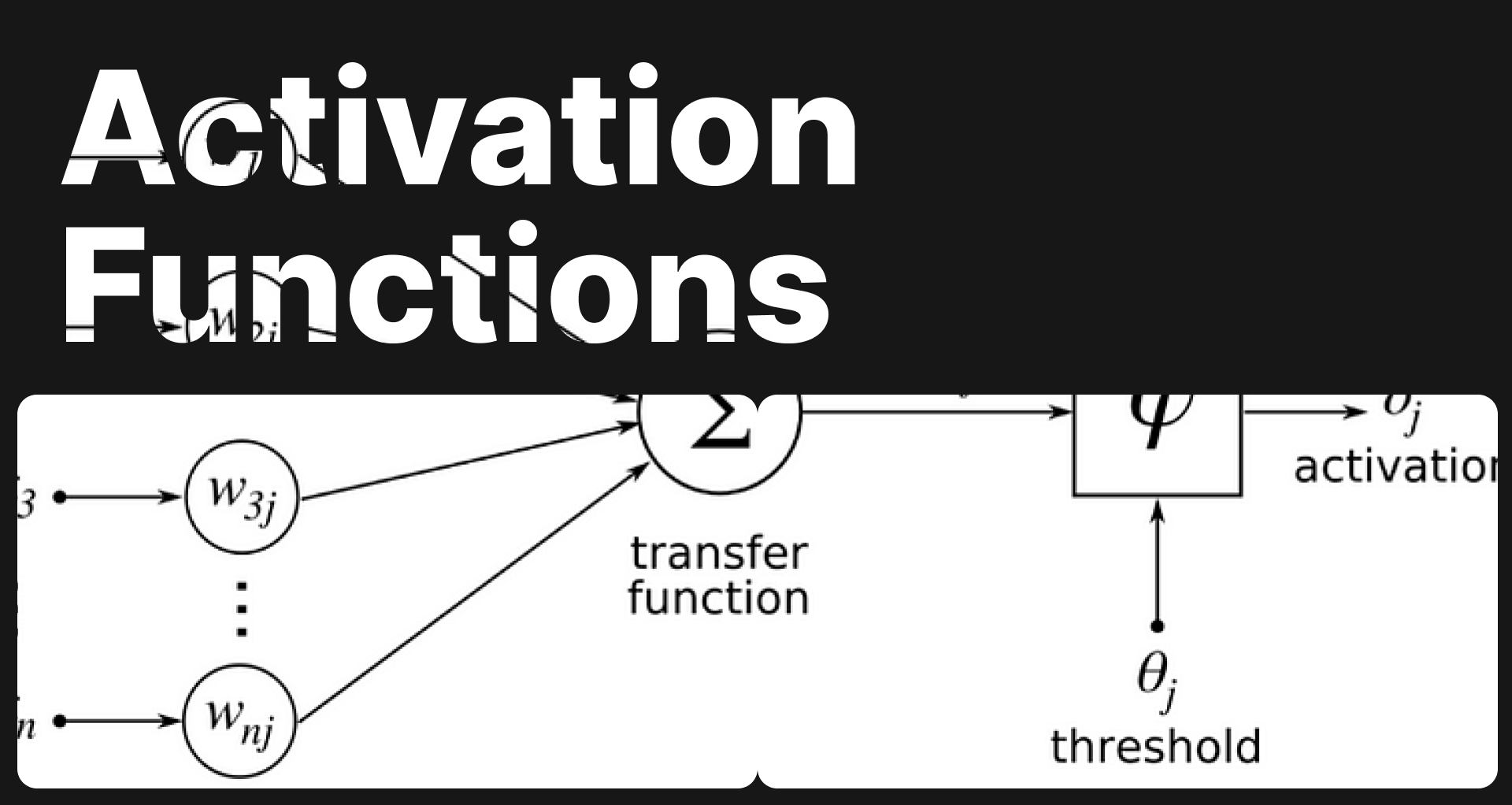
In the early days of Deep Learning, training deep networks was a nightmare. Models would "stall," gradients would disappear into thin air, and training took ages. Then came the Rectified Linear Unit (ReLU). It wasn't a complex mathematical breakthrough; it was a simple "gate" that changed everything.
1. The Anatomy of the Gate
At its core, ReLU is a piecewise linear function that outputs the input directly if it is positive; otherwise, it outputs zero. It acts much like a biological neuron: it either reaches a threshold to "fire," or it remains silent.
The Mathematical Identity
The function is defined by the following expression:
Where the derivative (the gradient used for learning) is:
2. Why ReLU Replaced Sigmoid and Tanh
Before ReLU became the default, functions like Sigmoid and Tanh were the standard. However, they suffered from a fatal flaw in deep architectures: the Vanishing Gradient Problem.
As inputs for Sigmoid become very large or very small, the slope of the function becomes nearly horizontal. In backpropagation, we multiply these tiny gradients together. By the time the signal reaches the early layers of a deep network, it is so small that the model effectively stops learning.
The ReLU Advantage
- Non-Saturating Gradient: For all positive values, the gradient is a constant. This ensures that the "learning signal" doesn't fade away, no matter how deep the network is.
- Computational Efficiency: Sigmoid involves expensive exponential calculations. ReLU only requires a simple comparison (
if x > 0), making it significantly faster to compute during both training and inference. - Representational Sparsity: In a random initialization, roughly 50% of the neurons will output zero. This creates a "sparse" representation, which is often more efficient and less prone to noise.
3. The Achilles' Heel: The "Dying ReLU"
ReLU is powerful, but it isn't perfect. It suffers from a phenomenon known as the Dying ReLU problem.
If a large gradient flows through a ReLU neuron during training, the weights might update in a way that the neuron always outputs a negative value. From that point on:
- The output is always 0.
- The gradient is always 0.
- The neuron is "dead" and will never recover, as no gradient can flow back to update its weights.
The Evolution: Leaky ReLU and Friends
To solve this, researchers introduced variations that allow a small, non-zero gradient when the input is negative:
- Leaky ReLU: . It ensures that even "inactive" neurons can still learn, albeit slowly.
- ELU (Exponential Linear Unit): Uses a log curve for negative values to make the mean activations closer to zero, which speeds up training.
4. Best Practices for Implementation
If you are building a model today, follow this "industry standard" checklist to ensure ReLU performs at its best:
| Strategy | Why it matters |
|---|---|
| He Initialization | Since ReLU shuts off half the neurons, you need specific weight variance to keep the signal steady. |
| Lower Learning Rate | Helps prevent "knocking" neurons into the permanent negative (dead) zone. |
| Batch Normalization | Keeps the inputs to the activation function in a healthy, active range. |
Monitoring Tip: If you use Weights & Biases, keep an eye on your Activation Histograms. If you see a massive spike at exactly zero that never moves, you likely have a Dying ReLU problem.
ReLU is the gatekeeper because it manages the flow of information with brutal efficiency. By blocking negative "noise" and providing a clear, non-fading path for positive signals, it allowed us to move from shallow networks to the massive Deep Learning models—like Transformers and ResNets—that define the modern AI era.